House as prison
The House of Bernarda AlbaThe House as prison is the play’s central spatial image: Bernarda’s home is at once a recognisable village house and a stage-bound expression of the women’s confinement. Its thick walls, closed doors, and oppressive silence shape what the characters can see and do, while Bernarda’s rules make enclosure a social condition as well as an architectural one. The image recurs through the three acts, linking domestic authority to the daughters’ restricted lives and to the tragedy that follows.
The House as a Stage Image
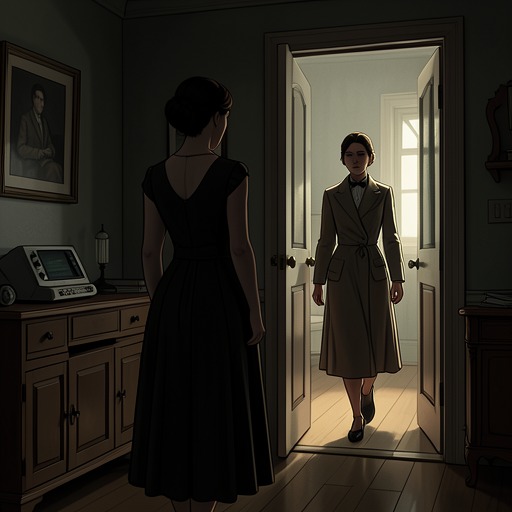
The play begins in a very white interior, with thick walls, arched doors curtained with jute, rush-bottomed chairs, and an enveloping silence interrupted by tolling bells. The stage is empty when the curtain rises. Before the family appears, the setting has already established an enclosed world: the walls suggest the solidity of a real home, but their weight and the silence make the room feel oppressive. The stark whiteness also carries the suggestion of the daughters’ chastity and the monotonous routine of their lives.
The three settings—two inner rooms and, in the final act, the inner courtyard—remain recognisable parts of a household. Yet the repeated walls, doors, and subdued atmosphere make the house more than a realistic backdrop. Its rooms and thresholds give physical form to the women’s separation from the world outside, and the play’s successive interiors sustain the sense that the action is moving deeper into confinement.
Rules, Thresholds, and Confinement
The image gathers force in the rules governing the household. Bernarda announces eight years of mourning as though the doors and windows were to be sealed. María Josefa is locked in her room; after she escapes, Bernarda orders that she be locked up again. Magdalena calls the place a dark room, while Poncia compares her service there to life in a convent. These details make confinement both imposed and repeated: escape is momentary, and authority restores the barriers.
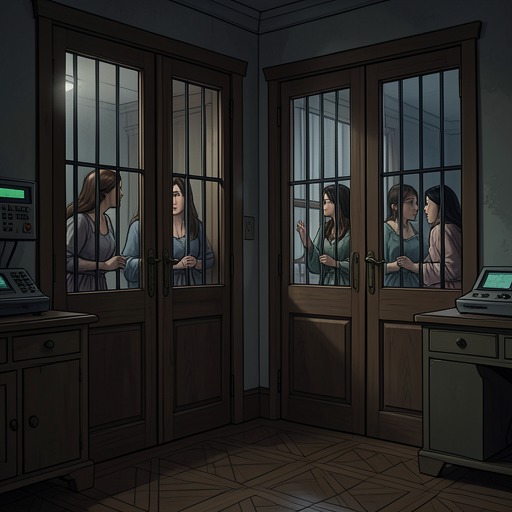
The barred window where Angustias and Pepe el Romano conduct their courtship marks a threshold between the household and the outside world, but not an open passage through it. Bernarda describes herself as jailer to her daughters, imagining five chains, one for each of them. In Act Three, Adela takes her mother’s stick and breaks it, declaring that Bernarda is no longer her jailer. The gesture makes the prison image a direct conflict over who has the power to govern the women’s lives.
Sound Beyond the Walls
The house is not acoustically sealed. Sounds cross its boundaries and bring the outside close, without making it accessible. The opening bells establish the village beyond the stage; later, tambourines and carrañacas are heard while the women listen in silence, and Martirio says that the harvesters reap in tongues of fire. The sound offers a contrast to the enclosed household, but the women remain inside, hearing a world from which they are cut off.
The stallion’s blows against the stable wall make enclosure audible in another way. Bernarda identifies the horse as locked in the stable and orders that it be hobbled and released into the yard, a response that keeps the animal within the bounds of the house even as it resists them. Near the end, Poncia hears dogs barking and the Servant suggests someone has passed the front door. Such offstage sounds extend the dramatic space beyond the walls, while also sharpening the suspense of what the household’s watchfulness may detect.
Surveillance and the Ending
Enclosure is enforced not only by doors and walls but by Bernarda’s belief that her vigilance can master the house. After Martirio leaves, Bernarda says she is enjoying the silence and cannot see the great thing Poncia claims is happening there; she then insists that her surveillance can control everything. The exchange exposes the difference between the order she asserts and the hidden realities that continue within the household.
After Adela’s death, Bernarda returns to mourning and silence, anticipating confinement more severe than before. The house that has already restricted the daughters becomes the setting for renewed control, rather than a space opened by the crisis. Its prison image therefore binds the play’s realistic village home to its wider social criticism: domestic walls embody the women’s isolation, while the repeated effort to preserve order makes that isolation endure.